Executive field guide · 2026
Amsterdam field notes | October 2026
The enterpriseafterthe chatbot.
Dean McCoubrey is Humaine's Chief AI Strategist, Enterprise AI Transformation Expert, and AI Keynote Speaker. He shares what Amsterdam's World Summit AI 2026, in October, reveals about agents, enterprise intelligence and the difficult work of transformation.
Dean McCoubrey | Chief AI Strategist | Enterprise AI Transformation Expert | AI Keynote Speaker
From answers to accountable execution
An independent executive interpretation of World Summit AI 2026, informed by published summit materials and external research. Views and recommendations are the author's, not those of the summit or its speakers.
Programme reference: WSAI official agenda (opens in a new tab)
Chapter 00
Author's letter
A letter from Amsterdam
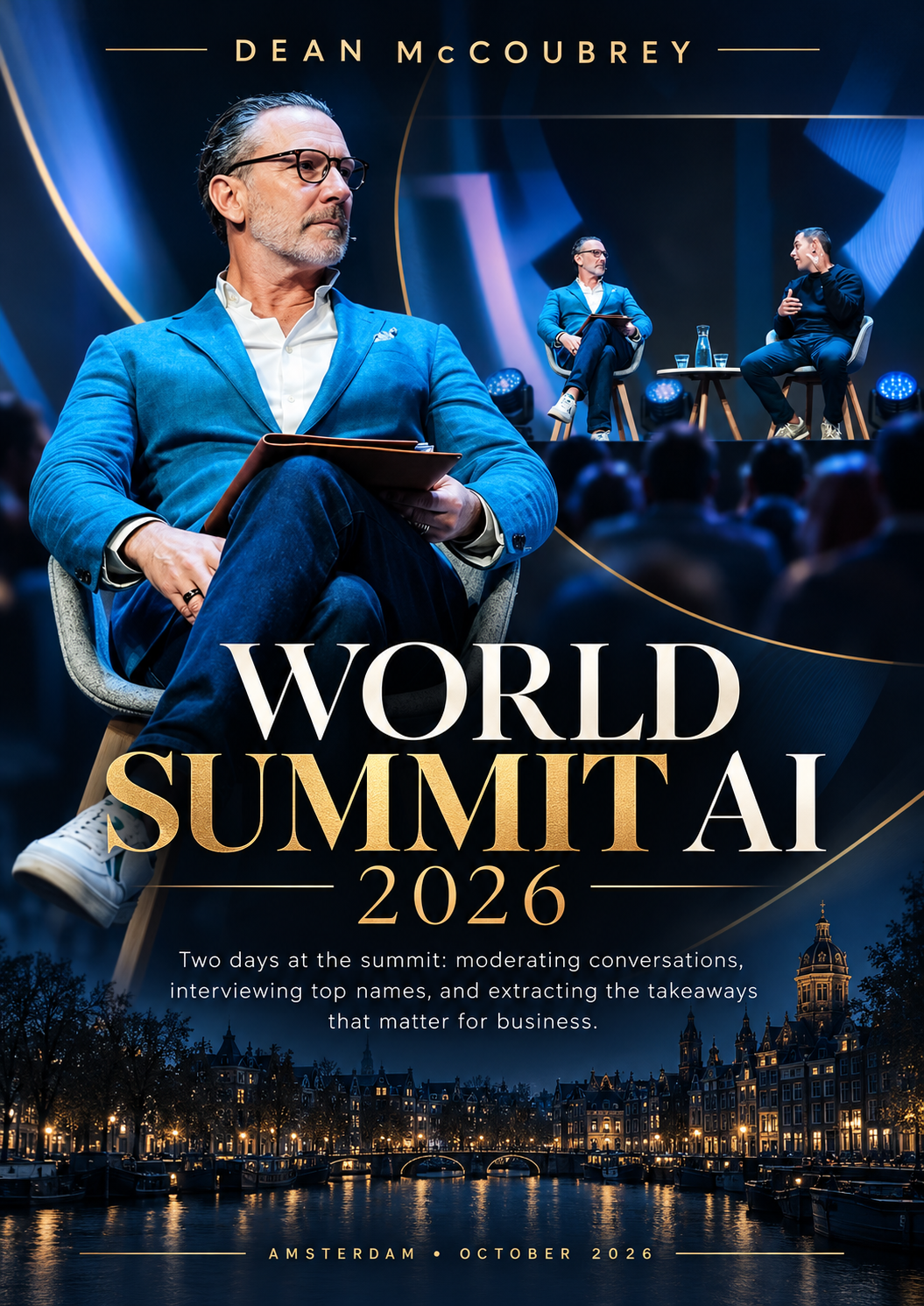
At World Summit AI in Amsterdam this October, the conversation moved well beyond the question of which model could produce the best answer. I moderated discussions on how a global travel business interprets human intention and how the infrastructure behind AI agents copes with execution, latency and scale. On 7 October, on the ADOPT AI stage, I hosted Xavier Amatriain, Chief AI and Data Officer at Expedia Group, for a session titled "Human intention to intelligent itineraries". On 8 October, on the mainstage, I moderated David Casem, CEO and co-founder of Telnyx, in "Beyond the model: Execution, latency and scale in the age of AI agents".[3][1]
The details differed, but the operational problems were recognisable. It is difficult enough for a company to make one intelligent prediction. It is considerably harder to maintain a reliable chain of decisions across customer systems, proprietary data, approvals and changing commercial circumstances. The executive team still owns the outcome, whatever proportion of the work a system performs.
I have spent much of the past decade examining how emerging technologies shape human behaviour, particularly through my work on social media literacy and online safety. The lesson I keep returning to is how quickly organisations and individuals adapt their routines to a new capability before they fully understand its effects. AI is now becoming embedded in the way people learn, write, decide and work. Enterprise leaders carry the additional responsibility of integrating it into shared processes in which an error may affect customers, colleagues, regulatory obligations or the company's finances. Technology procurement will not answer those organisational questions.
This paper is my interpretation of what the summit's published programme and the wider research suggest for senior leaders. It is written for chief executives, boards and the executives who will be asked to make agentic systems work in practice. Where I refer to a session, I refer to its published title and synopsis; I do not attribute claims to speakers beyond that. It is an executive field guide, not a peer-reviewed study, and the interactive tools within it are conceptual aids designed to sharpen judgement.
Dean McCoubrey, Amsterdam, October 2026
The research gap
Adoption, productivity and financial impact are separate stages
said they were scaling AI agents in at least one function.
Denominator: respondents at companies with annual revenue above $1 billion
qualified as AI high performers: at least 5% of EBIT attributed to AI, and value described as significant.
Denominator: all 1,719 respondents across 97 nations
These two figures come from different populations within the same survey. They are not a conversion ratio, and dividing one by the other would produce a fabricated success rate. All figures are respondent self-reports. Source: McKinsey, The state of AI, 25 August 2026.[4]
Of all respondents: reported individual productivity benefits
McKinsey's August 2026 global survey illustrates the tension.[4] Among respondents from companies with annual revenue above $1 billion, 40% said they were scaling AI agents in at least one function. Across the entire sample, just 6% qualified as AI high performers. The more useful observation is that adoption, individual productivity and enterprise-level financial impact are distinct stages of change, each with its own evidence requirements. The survey also found that 80% of respondents reported individual productivity benefits, while around one in five organisations had constrained some AI use because of operating costs.
A separate survey of US chief executives published by KPMG in October found that 9% described agents as transformational for their business.[5]That is a US sample with its own framing, and it should not be blended with the global figures. Read together, the two sources suggest broad activity and cautious executive judgement about what that activity has so far achieved.
Chapter 01
An answer is no longer the unit of work
The first wave of enterprise generative AI was organised around the answer. A person asked, a model replied, and the person decided what to do with it. Responsibility stayed obviously with the human because nothing happened until they acted. Agentic systems change the unit of work. The system is given an outcome to pursue, and it may take many steps, across hours or days, before anyone reviews the result.
A mission-oriented AI system begins with a specified outcome. It needs to assemble authorised context, break the assignment into well-defined activities, select appropriate tools or models, track intermediate results, identify uncertainty and route certain decisions to a person. Each piece can appear straightforward in isolation; production reliability depends on the whole chain. The relevant evaluation is therefore how often the end-to-end system produces a correct, useful and appropriately authorised outcome under realistic conditions. A polished demonstration tells management little about that. Evaluations such as METR's work on task time horizons show how capability on longer tasks is being studied, and also how much the results depend on the tasks and definitions chosen.[9]
Educational comparison
- Prompt
- Answer
- Person decides
- Duration
- Seconds. One exchange, then the session ends.
- State
- Little or none beyond the conversation window.
- Dependencies
- The model and whatever the user pastes in.
- Delegation
- None. The person does all the work after reading.
- Error recovery
- The person notices and asks again.
- Permissions
- Read only; usually no access to company systems.
- Human sign-off
- Implicit: nothing happens unless a person acts.
Conceptual illustration, not a live model or actual case
- 01Intention
- 02Context
- 03Plan
- 04Specialist steps
- 05Tools and data
- 06EvaluationQuality check
- 07Human controlApproval gate
- 08Outcome
Outcomes and errors feed back into context and planning for the next cycle.
Chapter 02
Context is infrastructure
Context engineering deserves attention at the executive level because institutional knowledge is rarely contained in one clean database. Organisations operate through contracts, CRM records, policies, informal conventions, permissions, legacy software and exceptions. An agent asked to resolve a supplier dispute must know which agreement is in force, what authority the staff member has, whether the data is current, how escalation works and what it is prohibited from doing.
The organisation should be able to identify the provenance of the facts the system relied upon. That requires identity and permission models that extend to agents, retrieval that returns sources with its results, and owners for the quality of each critical data set. No vendor brochure can substitute for that work, and it is usually the slowest part of any serious deployment. Leaders who budget for it early tend to avoid the pattern in which a successful pilot stalls because the production data is messier than the demonstration data.
The summit's published presentations included decks titled "Context as the foundation for proactive AI grounded with enterprise governance" from Glean and "Building agents that improve over time" from LangChain.[2] I cite those titles as evidence of where the industry conversation sits, not as a summary of their content.
The context stack · select a layer
Chapter 03
A model strategy is an economic decision
Model selection changes when decisions have consequences. The most capable model is not always the economical option for a narrow task. Some work benefits from smaller or specialised models, deterministic code, conventional search or a human expert. Other tasks justify more expensive frontier reasoning. Leaders need to know where accuracy, latency, privacy and total cost shift the decision, and those points differ by task.
A route that calls a frontier model six times and a verification model twice can have very different economics from a simple single-answer assistant. Both should be tested against actual business tasks before procurement decisions harden into dependency. Open-weight and distilled models offer more control over data residency and cost, at the price of in-house evaluation and operations. Model routing can reduce cost while preserving quality on difficult cases, but it adds another component that must be monitored. Vendor concentration is a strategic risk in its own right; the Stanford AI Index documents how capability and investment have clustered among a small number of developers.[6]
The summit programme gave substantial space to infrastructure, inference and deployment economics.[1] McKinsey's October paper on an "AI operating system" for the enterprise proposes treating these choices as part of how the company is run.[7] That is a consultancy's proposal and should be read as one, yet its central point is sound: model choice is an operating-model question with a recurring cost, and it deserves the same scrutiny as any other long-term supplier commitment.
Trade-off map
Hypothetical positions, not benchmarks
A router sends routine steps to cheaper models and escalates hard cases. Adds orchestration and testing overhead.
Chapter 04
Orchestrating work
Multi-agent designs divide a mission among components with distinct responsibilities. One plans, others retrieve and analyse, one acts, one verifies, and a control layer decides what needs a person. The value of the division is less about cleverness than about inspection: each role can be tested, permissioned and logged separately, which makes failures easier to locate. The cost is coordination, and every handoff is a place where context can be lost or latency added.
The scenarios below are deliberately ordinary. Each surfaces one evaluation and one approval gate, because those two points are where reliability and accountability are usually decided. They are not drawn from any company's systems or from the summit sessions.
Conceptual simulation: no live agents, no business decisions executed
Chapter 05
The economics of intelligence
The economic case for agentic AI is usually presented as time saved. Time saved is a capacity figure, and it becomes money only if the organisation does something with that capacity: handles more volume without hiring, redeploys people to work that earns revenue, or reduces cost deliberately. Each of those is a management decision with its own consequences. Boards should therefore ask for five distinct measures and resist letting one stand in for another: individual productivity, EBIT contribution, revenue, customer outcomes and measured error rates.
The evidence base reflects that gap. McKinsey's respondents widely reported productivity benefits while only a small minority attributed material EBIT impact to AI, and around one in five had constrained some use because of operating costs.[4] KPMG's US chief executives were similarly measured about agents.[5] Operating cost deserves particular attention with agents, because a single task may trigger many model calls, and oversight time is a real cost that pilot business cases often omit.
Illustrative monthly net capacity value
5,000
- Hours released
- 200
- Gross capacity value
- 10,000
- Oversight cost
- 2,000
- Payback indication
- 12.0 months
Net = (tasks × minutes ÷ 60 × hourly cost) − oversight hours × hourly cost − infrastructure.
- This is capacity value, not guaranteed cash savings.
- Redeployed time does not automatically become savings; it requires a decision about how the capacity is used.
- Quality, throughput and error rates must be measured before and after; this tool assumes quality is unchanged.
- No empirical performance improvement is implied. Every input is yours.
Chapter 06
Human change is operational
Human factors are often treated as a final workstream. In practice, people determine whether the new process can work. Employees need to understand which parts of their roles are changing, what decisions they remain accountable for, how errors are escalated and what good performance now looks like. If the company rewards speed while privately expecting exhaustive human checks, it will create a contradiction in daily work, and people will resolve that contradiction in ways management cannot see.
My nine years of work on social media literacy and digital safety taught me that adoption does not follow capability automatically. Habit, social influence, trust and incentives shape what people actually do with a tool, often more than its features. In families and schools, the same app could be used carefully or harmfully depending on the norms around it. Organisations behave similarly. Teams copy what respected colleagues do, avoid what feels risky to their standing and quietly abandon tools they do not trust. That is an observation from practice, and I would be cautious of anyone claiming neuroscience proves that a particular change programme will work.
The practical response is operational. Train people on the specific workflows they will use, with real cases. Redesign roles explicitly and say where reassignment or upskilling is planned. Consult staff genuinely, early enough that their knowledge of exceptions can change the design. Build psychological safety so that reporting an agent error is treated as useful information. Align incentives with quality as well as volume, and keep human oversight meaningful by giving reviewers the time and authority to reject outputs. Leadership should measure quality, confidence and customer outcomes alongside productivity. The independent AI For All recap of the summit placed similar emphasis on workforce literacy and oversight.[10]
Chapter 07
Accountability must travel with autonomy
Governance becomes an operational discipline when agents can take action. The risk is no longer confined to the accuracy of a displayed answer. An authorised system might send the wrong message, retrieve information beyond its intended purpose, create a flawed record or fail to stop after circumstances change. Permissions, audit trails, monitoring, testing, incident response and human escalation must follow the action through the process.
The NIST AI Risk Management Framework provides a useful structure through Govern, Map, Measure and Manage.[8] It is voluntary, and individual controls need to be matched to the relevant use case and legal jurisdiction. In practice that means scoped agent permissions, careful handling of sensitive data, logs that let an auditor reconstruct a decision, evaluation sets that reflect real cases, the ability to roll back and to halt a system quickly, a defined incident path and a regular review cadence. The Stanford AI Index tracks how governance activity and documented incidents have grown alongside capability.[6]
Sovereignty adds a further layer, and the summit ran a dedicated Sovereign AI Forum within its programme.[1] For an enterprise, the stakes are concrete. In data terms, where information is stored and processed and who can compel access to it. In infrastructure terms, whether compute is available in the required jurisdiction. In legal terms, which regulator and which contract law apply. In procurement terms, whether the company can move workloads to another vendor without rebuilding its systems. Portability should be tested, not assumed.
Chapter 08
The first 90 days
One consequence for boards is that AI strategy belongs within enterprise strategy, operating-model design and risk management. The board should expect a portfolio of clearly valued opportunities with named business owners, evidence of system reliability, an explanation of the full cost to operate, workforce implications and explicit criteria for scaling or stopping. The first 90 days can establish those habits. The objective is to fund a small number of measurable business improvements and build the company's capacity to make better decisions about what comes next.
Days 0 to 30
Map and baseline
- Map candidate missions against business objectives
- Baseline current cost, time, quality and error rates
- Classify data and entitlements
- Assign ownership and record risks
- Owner
- Executive sponsor with a named business owner per mission
- Deliverable
- Ranked mission portfolio with baselines and a risk register
- Go / no-go threshold
- Proceed only where a baseline exists and the data owner has approved access
- Human sponsor
- Chief executive or a delegated executive committee member
- Why not rushed
- Without baselines, later results cannot be distinguished from noise or optimism.
Interactive tool
10-point boardroom readiness audit
A directional, author-designed tool. It is not a validated diagnostic or a universal benchmark. No data is collected; your answers stay in this browser tab.
- 01An accountable executive sponsor owns AI outcomes
- 02Use cases are ranked against business objectives
- 03Baseline economics exist for priority processes
- 04Data entitlements and context are documented
- 05A model selection policy guides choices
- 06Agent permission boundaries are defined
- 07A realistic evaluation dataset exists
- 08Monitoring and an incident path are in place
- 09The workforce is trained and participating
- 10Scaling investment is gated by evidence
One page executive brief
Six conclusions for the board
- 01
Treat the mission as the unit of work.
Evaluate end-to-end outcomes under realistic conditions, not the quality of individual answers.
Read the chapter - 02
Fund context before scale.
Identity, permissions, data quality and provenance decide whether agents can be trusted with action.
Read the chapter - 03
Make model choice an economic policy.
Test frontier, specialised, routed and non-AI options on real tasks, and plan for vendor portability.
Read the chapter - 04
Separate capacity from cash.
Report productivity, EBIT, revenue, customer outcomes and error rates as distinct measures.
Read the chapter - 05
Design the human system deliberately.
Roles, incentives, training and psychological safety determine whether the process works.
Read the chapter - 06
Gate expansion on evidence.
Use a 90-day cycle with owners, baselines, controls and explicit criteria to scale or stop.
Read the chapter
Executive questions answered
- What should CEOs put in place before adopting AI agents?
Choose a bounded business mission, name its executive owner and establish the current cost, quality and error baseline. Define data access, approval boundaries and the conditions for stopping before a pilot begins. Expansion should follow evidence from realistic work and funded operating controls.[8]
The first 90 days- How does an agent mission differ from a chatbot answer?
A chatbot usually returns an answer for a person to act on. An agent mission carries state across multiple steps, depends on company systems and may take authorised actions. Evaluate the completed outcome, including recovery from exceptions and human sign-off, rather than judging a single response.[9]
The unit of work- What does context engineering mean for an enterprise?
It means supplying the authoritative information, identity, permissions and provenance needed for a particular task. The paper treats freshness, ownership and access boundaries as operational infrastructure. A capable model cannot compensate reliably for outdated policy, conflicting records or missing entitlements.
Context is infrastructure- How should leaders choose an AI model?
Compare frontier, specialised, routed, deterministic and human approaches on representative tasks. Assess quality, latency, privacy, full operating cost and portability together. Model selection needs an explicit policy that can be revised as task requirements and economics change.
Model strategy- How should AI ROI be measured against time saved?
Separate released capacity from cash savings, revenue, customer outcomes and error rates. Compare results with a measured baseline and include integration, evaluation, oversight and incident costs. Time saved becomes a financial benefit only when the organisation can explain how that capacity changes its costs or output.[4]
The economics of intelligence- What makes agentic AI auditable?
Record which identity acted, which information and permissions it used, what decision followed and where approval occurred. Logs must allow a consequential action to be reconstructed, alongside clear escalation, rollback and halt procedures. Human reviewers need the authority and information to intervene meaningfully.[8]
Accountability and autonomy- What should a 90-day enterprise AI programme deliver?
Begin with mission selection, ownership, baselines and a map of data and controls. Run bounded pilots against realistic cases, including exceptions, then review economics, incidents and workforce implications. The final decision is whether evidence supports expansion, further revision or stopping.
The 90-day roadmap- What staff training supports enterprise AI transformation?
Train staff on the workflows they will actually use, including verification, exceptions and escalation. Involve them in redesign, clarify responsibility and align incentives with quality. Error reporting needs to be safe and actionable so that operating problems reach the people able to resolve them.[10]
Human change is operational
Evidence
Editorial sources
Summit published material establishes who spoke and which topics and titles were programmed. It is not used as evidence of what any speaker said.
Independent research supplies the survey figures and frameworks. Survey figures are respondent self-reports from the stated populations.
Author interpretation covers all recommendations, frameworks, scenarios and interactive tools in this paper. They are Dean McCoubrey's views, not the summit's or its speakers'.
- 1World Summit AI 2026 programme (opens in a new tab)Summit published material
World Summit AI · October 2026
Track themes and session listings. Used for topics and titles only, not as evidence of what any individual session asserted.
https://worldsummit.ai/programme/
- 2Speaker presentations 2026 (opens in a new tab)Summit published material
World Summit AI · October 2026
Selected presenter-approved deck titles. Titles are cited as topics; nothing here is presented as a quotation.
https://worldsummit.ai/speaker-presentations/
- 3Speakers 2026 (opens in a new tab)Summit published material
World Summit AI · October 2026
Official speaker list. Verifies the participation of Dean McCoubrey, Xavier Amatriain and David Casem.
https://worldsummit.ai/Speakers/
- 4The state of AI: global survey (opens in a new tab)Independent research
McKinsey & Company, QuantumBlack · 25 August 2026
1,719 respondents in 97 nations. Figures are respondent self-reports, not audited financial results.
https://www.mckinsey.com/capabilities/quantumblack/our-insights/the-state-of-ai
- 5KPMG 2026 US CEO Outlook (opens in a new tab)Independent research
KPMG US · 15 October 2026
Survey of US chief executives. 9% describe agents as transformational. A US sample, not a global one.
https://kpmg.com/us/en/media/news/kpmg-us-ceo-outlook-2026.html
- 6AI Index Report 2026 (opens in a new tab)Independent research
Stanford HAI · 2026
Annual review of AI capability, investment, policy and governance.
https://hai.stanford.edu/ai-index/2026-ai-index-report
- 7The AI operating system: a new way for CEOs to run the enterprise (opens in a new tab)Independent research
McKinsey & Company · 13 October 2026
A consultancy's proposed operating model. Treated as a strategic interpretation, not objective fact.
https://www.mckinsey.com/capabilities/quantumblack/our-insights/the-ai-operating-system-a-new-way-for-ceos-to-run-the-enterprise
- 8NIST AI Resource Center and AI Risk Management Framework (opens in a new tab)Independent research
US National Institute of Standards and Technology · Ongoing
Voluntary framework organised around Govern, Map, Measure and Manage.
https://airc.nist.gov/
- 9Measuring AI ability to complete long tasks (time horizons) (opens in a new tab)Independent research
METR · Ongoing
Agentic capability evaluation. Results depend on task suites and definitions; this paper does not extrapolate from them numerically.
https://metr.org/time-horizons/
- 10World Summit AI 2026: progress, people and practical AI skills (opens in a new tab)Independent recap
AI For All · October 2026
Non-profit summit recap with an emphasis on workforce literacy and human oversight.
https://aifourall.org/world-summit-ai-2026-progress-people-and-practical-ai-skills/
This is an executive field guide. It is not a peer-reviewed research study.
About Dean McCoubrey
Keynotes, training and insight on what AI does to organisations
Chief AI Strategist and enterprise AI transformation expert, based in South Africa and working internationally.
Dean McCoubrey is a Chief AI Strategist, enterprise AI transformation expert and AI keynote speaker from South Africa, working with companies and audiences internationally. He has spent much of the past decade examining how emerging technologies reshape human behaviour, organisations and the routines of working life.
At World Summit AI 2026 in Amsterdam he spoke and moderated on the mainstage, including conversations with leaders from Expedia Group and Telnyx on execution, latency, scale and the interpretation of human intention. This whitepaper is an example of the independent analysis he produces for executives, publications and media.
His work with companies focuses on the period ahead: the AI trends, opportunities and challenges that will define 2027, and the practical governance, workforce and economic decisions leaders need to make before agent systems take on real work.
- 01
Keynotes and moderation
Dean speaks and moderates on international stages, including World Summit AI 2026 in Amsterdam, on enterprise AI adoption, agent systems and the human side of technological change. His talks are built for executive audiences who need judgement, not hype.
- 02
Executive briefings and corporate training
He trains leadership teams and companies on what is coming in AI through 2027: the trends, the genuine opportunities and the difficult challenges. Sessions are grounded in current evidence and shaped around the organisation's own sector, obligations and appetite for risk.
- 03
Writing, publications and media
Dean writes insight pieces and analysis for publications and media, including his columns for Daily Maverick. He is available for commentary, interviews and commissioned analysis on AI adoption, governance and the changing nature of work.